



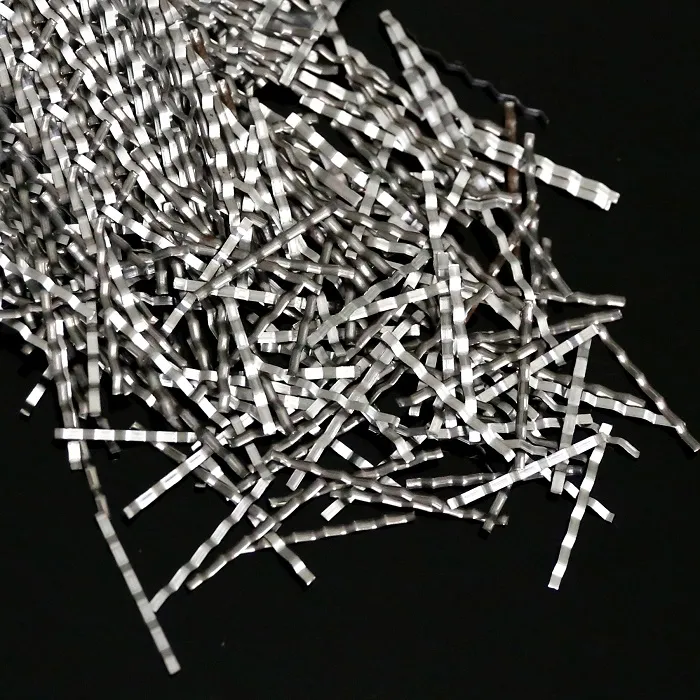
Steel fibers come in various types, each with its unique characteristics and applicable scenarios. When selecting steel fibers, it is essential to consider the specific engineering requirements and environmental conditions. Below are several common types of steel fibers offered by our company:
Hooked-End Steel Fiber: The tensile strength of hooked-end steel fibers typically ranges from 380 to 3000 MPa. During production, these fibers can be processed using cutters or punch presses. To improve production efficiency, rotary cutting tools are commonly used. However, because cold-drawn steel wire is relatively expensive, steel fibers produced using this method tend to have higher costs. The surface of hooked-end steel fibers is relatively smooth, resulting in lower bonding strength with substrates such as concrete. To improve the bond between the steel fiber and the concrete matrix, the production of deformed steel fibers can be employed. Common methods to enhance bonding include the use of pressed edges, corrugated designs, and hooked shapes.

Shear Steel Fiber: This type of steel fiber generally has a tensile strength of 600 to 900 MPa. The production process involves cutting cold-rolled thin steel sheets into fibers. Before cutting, a specialized small slitting machine is used to cut the cold-rolled steel coil into strips, with the width of the strips matching the desired length of the steel fibers. These strips are then continuously fed into rotating cutters or conventional punch presses for cutting. The axis of the rotary cutters is perpendicular to the feed direction of the thin steel sheet. Shear steel fibers are typically made from annealed cold-rolled steel, although unannealed cold-rolled steel can also be used to increase the strength of the fibers.

Milled Steel Fiber: The tensile strength of milled steel fibers is around 700 MPa. The raw materials typically used are thick steel plates or steel billets, which are processed using rotating flat-edged cutters. During the cutting process, the steel fibers undergo significant plastic deformation and axial torsion, which helps improve the bond between the steel fiber and the concrete matrix. When ordinary low-carbon steel is used as the raw material, the fibers, after being work-hardened, will exhibit a curvature approximately 2.5 times greater than the original material, resulting in a high-strength, high-hardness steel fiber.
Each type of steel fiber has its own unique production process and application areas. Selecting the appropriate steel fiber type can effectively enhance the performance of concrete and meet the diverse requirements of various engineering projects.

|
Product |
Diameter |
Length |
L/D |
Tensile Strength |
PCS/KG |
|
(mm) |
(mm) |
(MPa) |
|||
|
YA-65/35-BG |
0.55 |
35 |
65 |
1300 |
15300 |
|
YA-70/50-BG |
0.7 |
50 |
70 |
1200 |
6600 |
|
YA-80/60-BG |
0.75 |
60 |
80 |
1200 |
4800 |
|
YA-65/50-BG |
0.75 |
50 |
65 |
1200 |
5700 |
|
YA-65/60-BG |
0.9 |
60 |
65 |
1150 |
3300 |
|
YA-50/25-BL |
0.50 |
25 |
50 |
1300 |
25900 |
|
YA-55/30-BL |
0.55 |
30 |
55 |
1250 |
17800 |
|
YA-45/35-BL |
0.75 |
35 |
45 |
1150 |
8200 |
|
YA-50/50-BL |
1.00 |
50 |
50 |
1050 |
3200 |
|
YA-60/60-BL |
1.00 |
60 |
60 |
1050 |
2700 |
|
YA-65/13-CC |
0.2 |
13 |
65 |
2850 |
312000 |
|
YA-45/38-BS |
0.8 |
38 |
45 |
800 |
6600 |
|
YA-45/38-BM |
0.8 |
38 |
45 |
600 |
6600 |
FAQ
Q: Can steel fiber reinforced concrete be used in blast-resistant structures?
A: Yes, steel fiber reinforced concrete exhibits significant blast resistance, effectively enhancing the structure's impact resistance and reducing the damage caused by explosions. The inclusion of steel fibers improves the concrete's toughness, crack resistance, and fatigue resistance, allowing it to absorb energy and dissipate stress under extreme pressure. This enhances the overall stability and safety of blast-resistant structures.
Q: Can steel fiber reinforced concrete be used in nuclear power plant construction?
A: Yes, steel fiber reinforced concrete is widely used in the construction of nuclear power plants, particularly for improving the durability and safety of structures. Its excellent seismic performance, crack resistance, and impact resistance enable it to withstand extreme environmental conditions and structural loads commonly encountered in nuclear power plants, ensuring the long-term safe operation of the facility.
Q: Can steel fiber reinforced concrete be used for bridge reinforcement?
A: Yes, steel fiber reinforced concrete is commonly used in bridge reinforcement projects. The addition of steel fibers significantly improves the crack resistance, durability, and load-bearing capacity of bridge structures, effectively extending their service life while reducing maintenance and repair costs. It is especially suitable for reinforcing aging bridges, meeting high strength and long-term use requirements, and ensuring the stability of the bridge under traffic loads and environmental conditions.