



Introduction
Steel fiber dosage is the number that decides whether a fiber-reinforced slab performs as designed or merely looks reinforced. Specify too little and the concrete cracks where the reinforcement should have held it together; specify too much and you pay for fiber that the mix cannot disperse properly, ending up with balling, poor finish, and a workability problem on site.
Unlike rebar, where the design is a matter of bar diameter and spacing, steel fiber is dosed by mass per unit volume - kilograms per cubic metre of concrete. Getting that figure right requires knowing the fiber type, its aspect ratio, the application, and the performance the structure must achieve. This guide walks through the whole calculation.
Tangshan Yian Metal Products supplies steel fiber and PP fiber to concrete producers, shotcrete contractors, and precast plants, and we work through dosage questions with customers daily. The ranges below reflect what we see in practice across those projects.
What Dosage Actually Controls
Dosage sets the fiber content, and fiber content drives three properties at once: post-crack toughness, impact and fatigue resistance, and the residual flexural strength that design codes use to justify fiber reinforcement.
The key word is post-crack. Concrete without fiber carries load until it cracks and then fails abruptly. Steel fiber dosed correctly transfers stress across the crack, so the section continues to carry load and deflect in a controlled way. That behaviour is what allows a designer to reduce slab thickness, remove secondary mesh, or eliminate joints - but only at the dosage the design assumed.
Dosage is also what determines cost. Since steel fiber is sold by weight, the dosage figure converts directly into the material cost per cubic metre, which is why buyers pressure suppliers to quote the lowest defensible number. The trap is that a lower dosage changes the structural behaviour, not just the price.
The Inputs You Need Before Calculating
Four variables determine the answer:
Application. Industrial floors, shotcrete, precast elements, and refractory linings all sit in different dosage bands because the loads and failure modes differ.
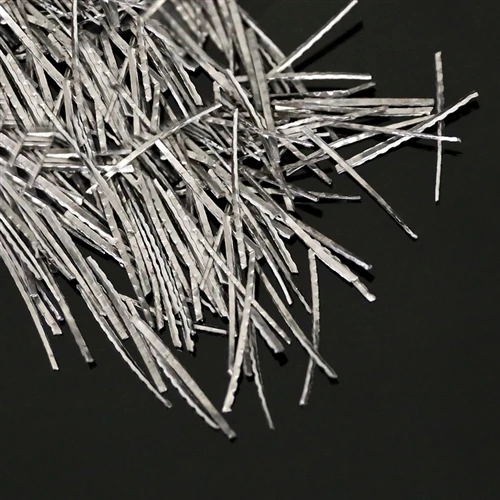
Fiber type and geometry. End-hooked, wavy, and straight micro fibers anchor into the matrix differently. Hooked fiber develops anchorage mechanically; straight micro fiber relies on bond along its length, so it often needs a different dosage for equivalent performance.
Aspect ratio (l/d). The ratio of fiber length to equivalent diameter governs how effectively fiber bridges a crack. Higher aspect ratio generally means more efficiency per kilogram - up to the point where fibers entangle during mixing.
Required performance. If a design calls for a residual flexural strength or a toughness class, the dosage follows from that requirement rather than from a table.
Typical Dosage Ranges by Application
The ranges below are practical starting points. Confirm the final figure against the design requirement, the fiber datasheet, and trial mixes.
| Application | Typical dosage | Notes |
|---|---|---|
| Slab-on-grade, warehouse floor | 20–40 kg/m³ | Often replaces secondary mesh at 25–35 kg/m³ |
| Industrial floor with heavy traffic | 30–45 kg/m³ | Combine with joint design and hardener |
| Shotcrete, tunnel lining | 25–45 kg/m³ | Higher dosage improves rebound control |
| Precast elements | 30–60 kg/m³ | Dependent on section thickness and cover |
| Refractory and high-temperature lining | 25–60 kg/m³ | Stainless or alloy fiber grades usually specified |
| Thin-walled or self-compacting concrete | 20–50 kg/m³ | Micro fiber preferred to avoid blocking |
Two rules of thumb are worth remembering. Below roughly 20 kg/m³, the improvement in post-crack behaviour is modest and the fiber may not be able to justify removing traditional reinforcement. Above roughly 60 kg/m³, workability and dispersion become the limiting factors, and a change of fiber geometry usually serves better than simply adding more mass.
How to Calculate Dosage from Performance Targets
Where the design specifies a performance class rather than a weight, work backwards:
- Identify the required residual strength or toughness class from the structural design - for example, a residual flexural strength at a given crack opening.
- Select the fiber type and aspect ratio that suits the application and the placement method.
- Use the supplier's performance data to find the dosage that achieves the requirement in a comparable concrete. Reputable suppliers publish dosage-versus-performance curves from beam tests.
- Validate with a trial mix using the actual aggregates, cement, and admixtures. Fiber performance is sensitive to the matrix, not only to the fiber.
- Confirm workability and finish at the chosen dosage before committing the full pour.
Step 4 is the one that projects skip. A dosage that works in one plant's mix can underperform in another's, because aggregate grading and cement content change how efficiently the fiber bonds.
Aspect Ratio and Why It Changes the Number
Aspect ratio is the most misunderstood variable in the specification. A fiber with a high length-to-diameter ratio can bridge cracks more effectively at a given mass, which is why micro and cold-drawn fibers often achieve comparable performance at lower dosage than thick, short fibers.
But high aspect ratio cuts both ways. Long, fine fibers entangle more readily, which raises the risk of balling during mixing and can reduce pumpability in shotcrete. The practical optimum for most site-mixed concrete sits in the middle of the range, and the correct answer depends as much on the batching and placing equipment as on the structural requirement.
If a mix is balling, the fix is usually a change to the charging sequence rather than a reduction in dosage: add fiber to the aggregate stream, keep the mixer at the recommended speed, and avoid adding fiber into a mix that is already wet.
Mixing, Workability, and Placement
Steel fiber reduces slump, so mixes are usually designed with a higher cementitious content or a superplasticiser to maintain workability. Plan for a short mixing time after fiber addition - enough to disperse without damaging the fiber or over-heating the mix.
For slabs, finishing must start earlier than with plain concrete because fiber reduces bleed water. For shotcrete, fiber dosage and nozzle technique interact strongly: the wrong combination increases rebound, which wastes both fiber and money. For pumped concrete, confirm that the pump and line diameter suit the fiber length before the pour, not during it.
Specification Checklist
When you specify steel fiber, state the following so that the dosage can be verified rather than argued about:
- Required dosage in kg/m³, with the application and slab thickness.
- Fiber type, geometry, length, and aspect ratio, plus the standard it is certified to.
- Performance requirement: residual flexural strength or toughness class, if applicable.
- Concrete grade, maximum aggregate size, and admixture regime.
- Placement method - direct discharge, pump, or shotcrete.
- Testing regime for acceptance, and who pays for trial mixes.
A dosage without a fiber specification and a test method is an instruction that cannot be enforced.
Common Mistakes Buyers Make
- Buying on price per kilogram without comparing performance. A cheaper fiber at a higher dosage can cost more than an efficient fiber.
- Skipping the trial mix. The matrix changes fiber performance more than buyers expect.
- Reducing dosage after the design is fixed. That changes structural behaviour, not just cost.
- Ignoring aspect ratio. It determines how much performance each kilogram delivers.
- Adding fiber to a wet mix. This is the most common cause of balling on site.
FAQ
Q1: How much steel fiber do I need per cubic metre of concrete?
For industrial slabs, 20–40 kg/m³ is typical; shotcrete usually runs 25–45 kg/m³; precast and refractory applications can require 30–60 kg/m³. Confirm against the design requirement and a trial mix.
Q2: Can steel fiber replace rebar or mesh?
For slabs-on-grade, steel fiber is commonly used to replace secondary reinforcement such as mesh, and sometimes to reduce slab thickness. Primary structural reinforcement usually still requires design verification.
Q3: What is aspect ratio in steel fiber?
It is the fiber length divided by its equivalent diameter. Higher ratios generally bridge cracks more efficiently, but very high ratios increase the risk of fiber balling during mixing.
Q4: What is the minimum effective dosage?
Below roughly 20 kg/m³ the post-crack contribution is limited and rarely justifies removing mesh. The effective minimum depends on the fiber type and the required residual strength.
Q5: Why does steel fiber cause balling in the mixer?
Usually because fiber is added to a mix that is already wet, or added too quickly. Charge fiber with the aggregates, keep the recommended mixing speed, and follow the supplier's sequence.
Q6: Does steel fiber change the concrete mix design?
Yes. It reduces slump and water demand changes, so mixes are normally adjusted with a superplasticiser or additional fines to maintain workability at the specified dosage.
Q7: Which standard covers steel fiber for concrete?
EN 14889-1 covers steel fibers for concrete, ASTM A820 specifies steel fibers for fiber-reinforced concrete, and ACI 544 provides guidance on specifying and proportioning fiber-reinforced concrete.
Conclusion
Steel fiber dosage is a structural decision expressed as a weight. Fix the application, choose the fiber type and aspect ratio, work back from the required performance, and validate the result in a trial mix before the pour.
Tangshan Yian Metal Products Co., Ltd. manufactures glued, loose, end-hooked, wavy, cold-drawn, and micro steel fiber, together with PP fiber, for floors, shotcrete, precast, and refractory applications. Send us your application, slab or section details, and performance requirement, and our team will recommend a dosage and supply trial quantities.